

Soutien aux personnes salariées qui sont touchées par la violence domestique
Soutien aux personnes salariées qui sont touchées par la violence domestique
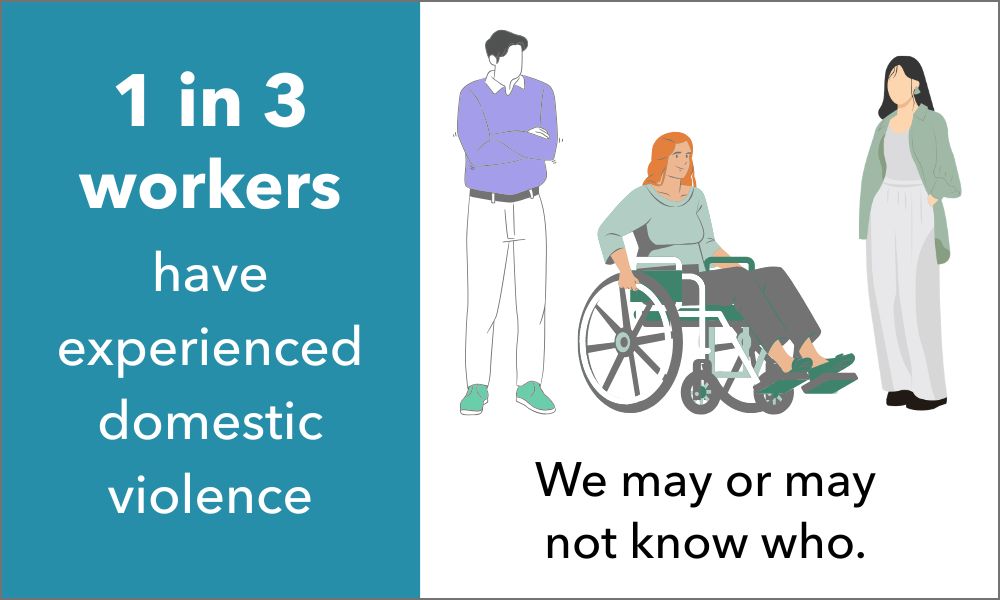
Un tiers des personnes en emploi au Canada ont vécu de la violence conjugale.1
La grande majorité (82%) des personnes salariées qui ont vécu de la violence conjugale ont déclaré que cela avait un impact négatif sur leur rendement au travail. Les actes préjudiciables et les difficultés physiques et mentales liées à la violence conjugale peuvent avoir des répercussions au travail pour les personnes touchées par la violence, les auteurs de violence et leurs collègues.²
Note sur la langue
Alors que les forces de l'ordre et le système judiciaire utilisent le terme “victime”, certaines personnes qui subissent des violences préfèrent le terme “personne ayant vécu de la violence conjugale”. Certaines organisations utilisent aussi “personne survivante de violence conjugale”.
Dans cette courte vidéo du Congrès du travail canadien, une femme témoigne de son expérience de violence conjugale, notamment du fait que son mari l'empêchait d'aller travailler.
La violence domestique est une question de pouvoir et de contrôle.
La violence conjugale désigne un ensemble de comportements utilisés par une personne pour exercer un pouvoir et un contrôle sur une autre avec laquelle elle entretient ou a entretenu une relation intime. Ces personnes peuvent être mariées, divorcées, en union libre, séparées ou en couple.
La violence peut prendre de nombreuses formes, telles que les insultes, les coups, les bousculades, les blocages, les étranglements, l'isolement, le harcèlement criminel, la violence numérique, le viol, les agressions sexuelles, le contrôle (émotionnel, mental et financier) et la manipulation.
Partir peut être compliqué
Il existe de nombreuses raisons pour lesquelles quitter une relation abusive peut s'avérer complexe et sembler impossible. L'auteur des violences peut avoir menacé de blesser ou de tuer la victime, ses enfants ou son animal de compagnie.
Elle restera peut-être parce que tout le monde le considère comme un “ bon gars ” et qu'elle sera jugée ou blâmée si elle part. Il restera peut-être parce qu'il a honte d'avouer qu'il est victime de violences.
Parfois, l'agresseur ou sa famille reprochent les violences à la personne qui en a subi, ou bien celle-ci se sent responsable. La famille peut insister pour qu'ils restent ensemble ou être opposée au divorce.
Même après la fin d'une relation et le fait qu'une personne soit passée à autre chose, des activités nuisibles peuvent se poursuivre.
Une liste des raisons pour lesquelles les femmes restent se trouve sur le Site Web de la Fondation canadienne des femmes.
Les personnes les plus touchées par la violence domestique
Toute femme, fille ou personne de genre non binaire est exposée au risque de violence domestique, quels que soient son âge, sa position sociale, sa réussite ou son origine.
Certaines personnes, notamment celles mentionnées ci-dessous, courent un risque plus élevé de subir des violences en raison des discriminations et des obstacles supplémentaires auxquels elles sont confrontées.3:
- femmes autochtones
- femmes qui vivent avec un handicap
- femmes racialisées
- personnes trans et non binaires
- femmes dans les zones rurales et isolées
- femmes mal logées ou sans abri
Bien que la majorité des personnes ayant subi de la violence soient des femmes ou s’identifient comme femmes, les hommes représentent environ 20 % de tous les cas de violence conjugale signalés à la police au Canada et environ 20 % des victimes d’homicides liés à la violence conjugale.4 Les hommes autochtones représentent une grande proportion (44 %) des victimes masculines d’homicide par partenaire intime.5
La violence domestique a des répercussions sur la santé mentale et physique

Les conséquences des violences conjugales sur la santé mentale peuvent être graves et rendre encore plus difficile la sortie d'une relation abusive.
La violence conjugale peut nuire à la confiance en soi, susciter de la peur et rendre difficile la conviction qu’un avenir plus sécuritaire est possible. Soixante-quatre pour cent des femmes vivant de la violence présentent des symptômes de trouble de stress post-traumatique (TSPT).3
Les femmes ayant subi des violences physiques présentent des taux de dépression significativement plus élevés. La consommation d'alcool peut être utilisée comme mécanisme d'adaptation ou d'automédication.3
Les problèmes de santé physique peuvent inclure des douleurs chroniques, un handicap, la fibromyalgie, des troubles gastro-intestinaux, le syndrome du côlon irritable, des troubles du sommeil et une diminution générale de la qualité de vie.3
Les femmes en situation de handicap et les femmes sourdes sont confrontées à des taux de violence disproportionnellement élevés, ce qui les expose à un risque accru de traumatisme crânien. Un traumatisme crânien peut également amplifier leur vulnérabilité et augmenter la probabilité de nouvelles violences.3
Impacts sur le lieu de travail
Au travail, les victimes et les auteurs de violences peuvent souffrir d'absentéisme, de difficultés de concentration et d'une baisse de leur rendement. Les auteurs de violences harcèlent souvent leur partenaire au travail, par exemple par courriel et SMS, ou en se rendant sur leur lieu de travail pour les harceler, les traquer ou les intimider. Ils utilisent également leur temps et leurs ressources professionnelles pour mener ces activités nuisibles.2
Les absences et les variations de charge de travail de leurs collègues peuvent avoir des répercussions sur ces derniers. La prise de conscience de violences conjugales peut engendrer chez eux stress et inquiétude.2
Il n'est pas rare que des collègues soient impliqués et, dans certains cas, deviennent eux-mêmes des cibles. Ils peuvent être harcelés, victimes de mensonges, voire agressés ou menacés par l'auteur des faits.2
La violence domestique ne reste pas confinée à la maison.
- 82 % ont déclaré que la violence domestique affectait négativement son rendement au travail (par distraction, fatigue, retards, interruptions au travail de la part de l'agresseur, mauvaise concentration et absentéisme).
- 53 % ont subi des violences sur son lieu de travail ou à proximité.
- 38 % ont signalé que cela affectait leur capacité à se rendre au travail
- 37 % ont déclaré que cela avait eu un impact négatif sur leurs collègues.
- 5 % ont perdu leur emploi à la suite de violences conjugales – 24% pour les personnes autochtones, noirs et de couleur
Source : Congrès du travail du Canada et l'Université Western. Peut-on être en sécurité au travail quand on ne l’est pas à la maison? Premières conclusions d’une enquête pancanadienne sur la violence conjugale et le milieu de travail.. 2014.
Conséquences économiques pour les femmes ayant subi de la violence
Les femmes ayant subi de la violence conjugale connaissent souvent un parcours professionnel plus instable et des revenus personnels plus faibles. Elles sont contraintes de changer d'emploi plus fréquemment et occupent plus souvent des postes occasionnels ou à temps partiel que les femmes n'ayant pas été victimes de violences.1
Certaines femmes ne reçoivent pas de lettres de recommandation, car leur employeur n'a constaté que les absences, les erreurs ou les interruptions du partenaire, et non le contexte.
Trouver un logement abordable reste un défi constant pour les femmes qui souhaitent quitter une relation abusive, surtout si elles ont des enfants et des animaux de compagnie. De plus en plus de femmes se retrouvent sans domicile fixe, contraintes de loger chez des proches. Certaines peinent à se loger en raison de dettes contractées sous la contrainte et d'une mauvaise cote de crédit.6
Un emploi stable et sûr est essentiel pour sortir d'une relation violente. La sécurité financière qu'il procure peut aider les personnes à fuir une relation abusive, à trouver un logement et à préserver leur qualité de vie et celle de leurs enfants.
Un emploi stable et sûr est une voie importante pour quitter une relation violente.
Que puis-je faire en tant qu'employeur ou collègue ?
S'assurer que les ressources sont facilement disponibles
Affichez des informations ou des liens vers des ressources sur les violences conjugales, quel que soit le genre, sur votre lieu de travail et assurez-vous qu'elles soient facilement accessibles au personnel dans un format compréhensible. Consultez la section « Ressources supplémentaires » ci-dessous pour des exemples.
Encourager le personnel à se renseigner sur la violence domestique
Près de 40 % des répondants à une étude pensaient avoir reconnu une personne ayant subi des violences domestiques et/ou un agresseur sur leur lieu de travail, beaucoup reconnaissant plus d'un signe avant-coureur.2
Accordez du temps au personnel pour qu'il puisse s'informer sur la violence conjugale ou suivre une formation afin de mieux la reconnaître et d'apprendre à réagir. Les formations suggérées ci-dessous, dans la section « Ressources supplémentaires », proposent des options pour l'ensemble du personnel, celui ou celle qui intervient auprès des personnes ayant subi de la violence conjugale et l'encadrement.
Élaborer une politique de lutte contre la violence domestique
Élaborer une politique et une procédure à suivre au cas où un membre du personnel se manifesterait avec des informations sur la violence domestique, que ce soit en tant que personne ayant vécu de la violence, auteur ou collègue inquiet.
Tenez compte de diverses expériences professionnelles et de vie
Les membres du personnel ont des parcours et des expériences professionnelles très divers. Il faut notamment prendre en compte les personnes en recherche d'emploi qui ont connu des périodes d'inactivité professionnelle ou qui ont occupé des emplois à temps partiel ou occasionnels.
Les employé(e)s arrivent au travail avec des situations personnelles diverses. Si la performance d'un employé(e) se dégrade, demandez-lui s'il ou elle a besoin d'aide. À son départ, envisagez de lui fournir une lettre de recommandation mettant en valeur ses points forts.
Plus important encore… croyez-les
L'une des choses les plus frustrantes pour les personnes ayant subi de la violence est de ne pas être crus.
Lorsqu'une personne vous confie des informations personnelles, écoutez-la. Croyez-la.
Demandez-leur comment vous pouvez les soutenir. Laissez-les prendre les devants et explorer ce qui est le mieux pour eux.
Lorsqu'une personne vous confie des informations personnelles, écoutez-la. Croyez-la.
Ressources supplémentaires
Centre de recherche et d'éducation sur la violence faite aux femmes et aux enfants de l'Université Western fournit des ressources gratuites sur son site web, y compris une évaluation de la préparation organisationnelle, un outil d'élaboration de politiques, une formation (pour tout le personnel, le personnel intervenant en cas de violence domestique et la direction) et un outil de dépistage des risques. (Disponible en anglais seulement.)
Western propose également le site Web Make It Our Business (Faisons-en notre affaire) site web avec de nombreuses ressources pour les lieux de travail sur la violence domestique. (Disponible en anglais seulement.)
Refuges pour femmes Canada fournit des informations sur la violence domestique et propose une formation de 90 minutes intitulée « Violence domestique et votre lieu de travail » pour reconnaître les signes de violence domestique, se sentir outillé pour soutenir les victimes et connaître les obligations légales d'un lieu de travail.
ShelterSafe.ca peut mettre les femmes en contact avec un refuge.Partout au Canada, les refuges offrent du soutien, des conseils en matière de sécurité et des programmes, ainsi qu'un hébergement. C'est un bon point de départ pour une femme.
Violences conjugales envers les hommes et les garçons : Informations et ressources est un site Web du gouvernement du Canada. Cela explique l'importance de demander de l'aide en cas de violence conjugale et comment obtenir cette aide.
TechSafety.ca offre de nombreuses trousses à outils pour aider les gens à sécuriser leurs appareils technologiques et à élaborer des plans de confidentialité et de sécurité numériques.
Les hommes survivants de violence conjugale : un résumé est un article du gouvernement du Canada qui résume les recherches et autres informations sur la violence conjugale envers les hommes au Canada.
Congrès du travail canadien – Centre de ressources sur la violence domestique au travail
Références
- Congrès du travail canadien et Université Western. Peut-on être en sécurité au travail quand on ne l’est pas à la maison? Premières conclusions d’une enquête pancanadienne sur la violence conjugale et le milieu de travail.. 2014.
- MacGregor, Jennifer CD, C. Nadine Wathen et Barbara J. MacQuarrie. 2016. “ La violence conjugale en milieu de travail au Canada : les collègues en sont-ils conscients ? ” Santé et sécurité au travail 7 (3) : 244-250. ISSN 2093-7911. https://doi.org/10.1016/j.shaw.2016.01.003 (Disponible en anglais seulement).
- Fondation canadienne des femmes. La violence fondée sur le genre : les faits. Consulté le 8 juillet 2026.
- Burczycka, Marta et Shana Conroy. 2018. Violence familiale au Canada : un profil statistique, 2016. Numéro de catalogue 85-002-X ISSN 1209-6393. Ottawa, ON : Statistique Canada.
- Conroy, Shana. 2021. Violence familiale au Canada : un profil statistique, 2019. Numéro de catalogue 85-002-X ISSN 1209-6393. Ottawa, ON : Statistique Canada.
- Centre canadien pour l'autonomisation des femmes. Logement équitable et abordable. Consulté le 8 juillet 2026.