
National AccessAbility Week
National AccessAbility Week
Every year, starting on the last Sunday in May


Join forces to build a fairer, more inclusive Canada.
This project was funded in part by the Government of Canada’s Accessible Canada Fund – National AccessAbility Week stream.

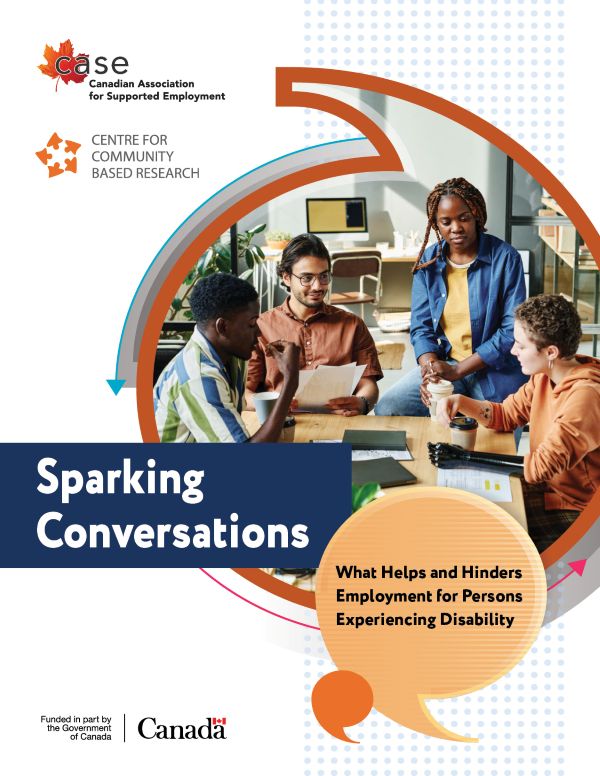
Sparking Conversations about What Helps and Hinders Employment for Persons Experiencing Disability
One in five workers in Canada experiences some type of disability (Statistics Canada, 2022).
Some of the biggest employment barriers faced by persons experiencing disability include stigma, lack of knowledge about disability, and rigid workplace policies.
You can help take down the barriers.

Credit: Small Group of Colleagues @ Jordon Nicholson/Disability:IN – CC BY-ND 4.0
Explore
Explore the employment journeys shared during this project by job seekers and workers experiencing disability.
Reflect
Reflect on the employment challenges faced by persons experiencing disability.
Talk
Talk with others about disability and how workplaces could be more inclusive of all workers.
Together, we can strengthen disability inclusion in workplaces and employment systems, locally, regionally, and nationally, one person and one conversation at a time.
Click on a link below to skip to a section on this page:
About the project
The Canadian Association for Supported Employment (CASE) partnered with the Centre for Community Based Research (CCBR) on a qualitative study to better understand what helps and what hinders the employment journey for persons experiencing disability. We wanted to learn more about people’s lived experience through their own stories.

- Fifteen job seekers and employees in Canada, each with unique experiences with disability and employment, shared what worked well and what made their employment journey harder.
- Representatives from two industry associations, ECO Canada and Tourism HR Canada, contributed employer perspectives around disability inclusion in the workplace.
One of the findings from this study is that lack of knowledge about both disability and workplace inclusion presents a recurring barrier to employment.
We encourage you to explore the participants’ stories. Reflect on disability and employment. Talk about it with others.
Every time we reflect on disability and employment and every time we have a conversation with others, it matters.
Sparking Conversations kit
The kit, Sparking Conversations: What Helps and Hinders Employment for Persons Experiencing Disability, was developed to share the findings from the study and to encourage people to reflect on and have conversations about disability and employment.
The kit was designed for anyone interested in learning more about disability inclusion. It also offers helpful, practical information for employment service providers and employers.
Included in the kit:
- About the project
- Key themes from the study
- Opportunities to improve employment and workplaces
- Employment journeys of 15 persons experiencing disability – 11 written and 4 on video
- Employer perspectives of workplace accessibility and inclusion – ECO Canada and Tourism HR Canada
- Activities for reflection and to spark conversations for anyone interested in learning more about disability inclusion and for employment service providers, employers, persons with lived experience, and community organizations
- Additional complimentary resources
Four participants share their employment journeys
Explore more participant stories in the following videos (link opens on CASE’s YouTube):
Video Transcripts
Design 1
Design 2
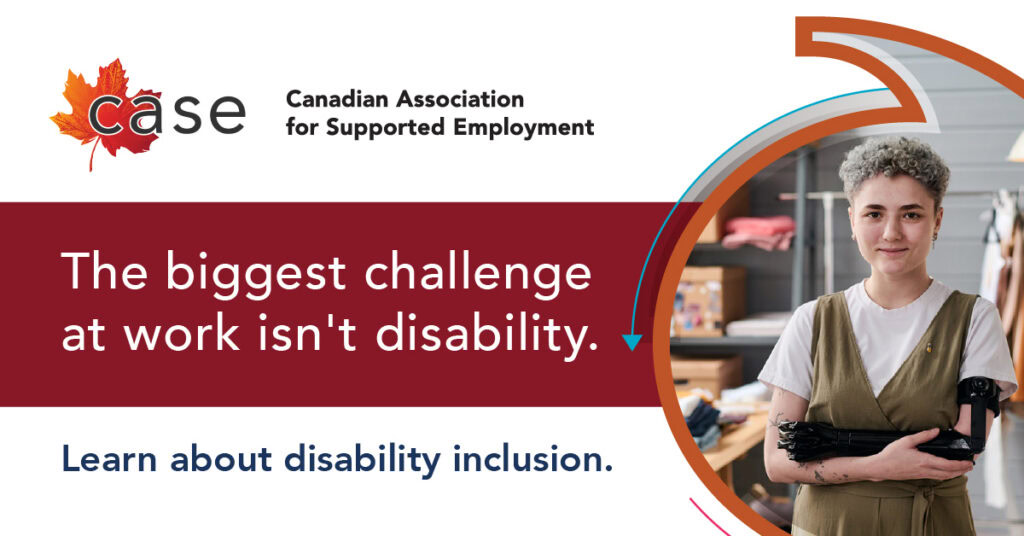
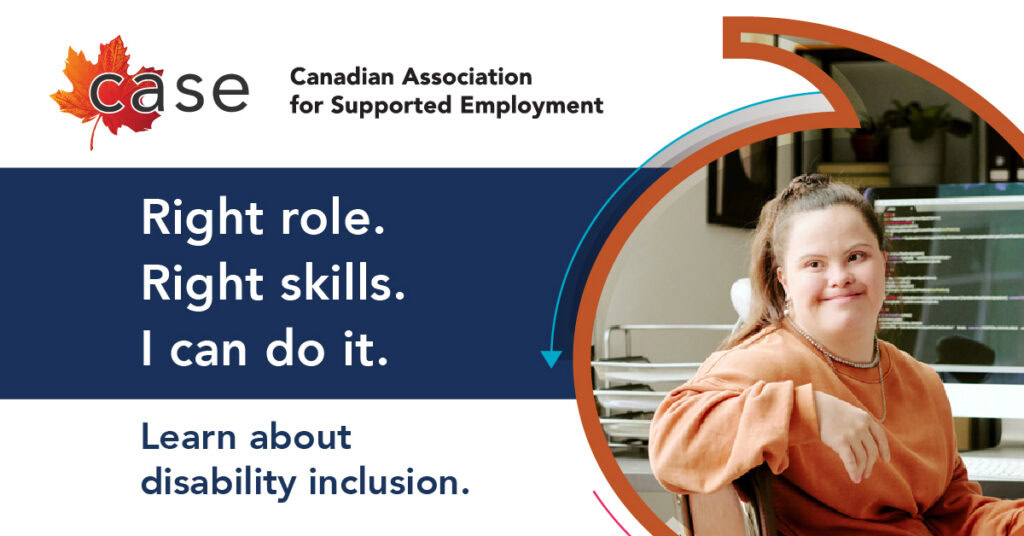
Download these social media posts (jpegs) to share across your networks.
Key themes from the study
Some patterns emerged across participants’ employment experiences. The following key themes appeared in multiple stories, suggesting systemic relevance rather than isolated experience.
More information about each theme can be found in the Sparking Conversations kit above.
Employment is non-linear and characterized by repeated “starting over.”
Employment trajectories were rarely stable or linear, with cycles of education, employment, illness, retraining, and more. These disruptions were not due to lack of motivation or ability but to health events, systemic inflexibility, and life circumstances.
Disability is often manageable; systems are not.
While disabilities could be accommodated, rigid employment systems made participation difficult or impossible. Fixed schedules, inflexible job design, mandatory physical presence, and narrow productivity norms were major barriers.
Inclusion depends on individuals rather than institutions (over-reliance on goodwill rather than rights).
Positive employment experiences frequently hinged on the actions of a single supportive person, such as a manager, employer, or job developer, rather than on formal policies or organizational structures.
Non-apparent disabilities create a constant disclosure dilemma.
Participants experiencing non-apparent disabilities described ongoing uncertainty around disclosure. Disclosure decisions were shaped by fear of bias, lack of safe spaces, and unclear benefits.
Digitalization has created a new accessibility divide.
Digital hiring systems, online interviews, and algorithm-driven platforms were both enabling and exclusionary. While remote work benefited some participants, others struggled with virtual interviews, digital-only communication, or inaccessible platforms.
Recognition, trust, and dignity are central to employment success.
Participants emphasized that being believed, respected, and recognized as capable mattered as much as formal accommodations. When employers trusted lived experience, participants felt safer and more productive.
Flexibility unlocks capability rather than lowering standards.
Flexible hours, task modification, remote or hybrid work, and pacing allowed participants to perform effectively without reducing expectations or quality of work.
Being judged before being recognized limits opportunity.
Many participants described being screened out before having the chance to demonstrate competence. Assumptions about disability often replaced evidence of ability.
Structural supports and employment intermediaries change outcomes.
When participants accessed employment intermediaries, advocates, or structured supports, their employment trajectories shifted significantly from isolation and confusion to clarity and opportunity.
Tokenistic inclusion versus meaningful power-sharing.
Participants differentiated between symbolic inclusion and real systemic change. Diversity statements without policies and processes designed in collaboration with persons with lived experience were widely viewed as ineffective.
Opportunities to improve workplace disability inclusion
Participants suggested clear, practical insights on how employment systems could be improved. Drawing directly from lived experience, these suggestions highlight opportunities for change at the organizational, policy, funding, and cultural levels.
Normalize flexibility in work design
Design work to accommodate human variability rather than rigid policies. Flexible hours, reduced workloads, and hybrid/remote options allowed people to manage health, pain, fatigue, and caregiving responsibilities without sacrificing productivity.
Create safer and clearer disclosure processes
Disclosure processes should not penalize job seekers. Many felt pressured to disclose too early or avoided disclosure altogether due to fear of bias. Disclosure should be optional, supported, and framed around access needs.
Improve hiring and interview practices
Design hiring processes that are clear, consistent, and accessible. Conflicting instructions, unclear expectations, and rushed interviews created unnecessary stress, particularly for neurodivergent candidates and those with anxiety.
Redesign job requirements and credentials
Eliminate credentials or driver’s license requirements that are not essential. Place value in transferable skills, lived experience, and demonstrated ability. Trial periods or probationary roles allow candidates to demonstrate competence rather than being screened out prematurely.
Strengthen workplace communication and trust
Inclusion depends on ongoing communication rather than one-time accommodations. Regular check-ins, open dialogue, and being believed when describing barriers created a sense of safety and stability. Trust is foundational to successful accommodation.
Address accessibility beyond physical entry
Proactive planning for daily needs, like commute times, washroom access, food preparation, personal care, and the timing of caregiver support, can make work more sustainable. Ask people what they need and let them lead.
Expand the role of employment intermediaries and job developers
When job seekers and employers work with employment intermediaries and job developers, outcomes can improve significantly. Recommendations included expanding funding and awareness of services and creating an employer network committed to inclusive hiring.
Provide mental health and trauma-informed supports
Mental health and trauma shape how people experience work. It’s essential to recognize emotional labour and isolation as part of the work experience. Regular check-ins, access to counselling, and trauma-informed management practices reduce anxiety and burnout.
Improve income and benefit systems
Income and benefit systems are misaligned with part-time, episodic, or fluctuating work capacity. Participants suggested reducing penalties and designing supports that encourage gradual and flexible participation in the workforce.
Move from tokenistic to meaningful inclusion
Equity statements and mandatory training are insufficient without lived-experience leadership and accountability. Policies, practices, and training should be co-designed with people who experience disability.
Interested in learning more about disability and employment?
CASE offers resources and training for employers and employment service providers.
- Complimentary resources and training for employers
- Additional resources and training for service providers
Social media posts to share