

Mentorship from the Lens of the Mentor
Mentorship from the Lens of the Mentor
While many people know about the benefits of mentorship for mentees, fewer are aware of the benefits to mentors.
In this post, we review the research around the benefits for mentors and their employers, and we discover the experiences of two MentorAbility mentors.
To read this post in French, click here. | Pour lire cet article en français, cliquez ici.

Credit: Desola Lanre Ologun via Unsplash
Nearly one in three adults in Canada has some experience as a mentor. Most people, whether they have been mentors or not, recognize that mentoring helps young people and that it benefits society (Mentor Canada, 2021), which is often what propels them to become mentors. Mentoring can also benefit adults who are re-entering the workforce or transitioning or wanting to advance in their careers.
For young people, mentoring can improve mental health, foster healthy relationships, and increase collaboration and communication across social and cultural groups (Mentor Canada, 2021).
For youth who experience disability, mentoring can improve social and decision-making skills and increase self-determination, confidence, and community participation. It can help youth plan and prepare for their education and career options (Mentor Canada, 2021).
One aspect of mentoring that may be less broadly understood is the mentor’s experience and the benefits to mentors. Many mentoring models are reciprocal and collaborative. They are more of a partnership between mentor and mentee, who both contribute to and gain from the interaction.
Mentoring is a partnership between mentor and mentee, who both contribute to and gain from the interaction.
Mentoring benefits mentors and employers
- Peer mentorship can enhance empathy in leaders.
- Mentors with mentees who experience disability and who may have other identities can deepen their understanding of inclusion and learn to recognize systemic barriers, which can lead some mentors to champion inclusive practices.
- Sharing their experiences and knowledge can help rejuvenate the career of seasoned employees.
- Mentoring can result in career benefits for mentors, including higher job satisfaction, better performance at work, and higher perceived career success (Gosh and Reio, 2013).
- Skills that can improve include active listening and learning how to be a more effective mentor (Heron et al, 2023).
- Enhanced organizational culture: mentoring helps to form professional relationships in the workforce, enhancing collaboration and understanding of others’ work and impact.
- Improved job retention: employees with disabilities are 1.5 times less likely to leave their jobs when organizations invest in employee-centred programs, like mentorship.
- Psychologically safe workplace: mentoring helps employees to feel valued and heard, strengthening mental health.
- Sustainability through cross-training: mentorship offers opportunities for cross-training for greater flexibility and creativity with tasks.
- More committed staff: individuals who provide mentoring can be more committed to their organization than those who have not been a mentor (Gosh and Reio, 2013).
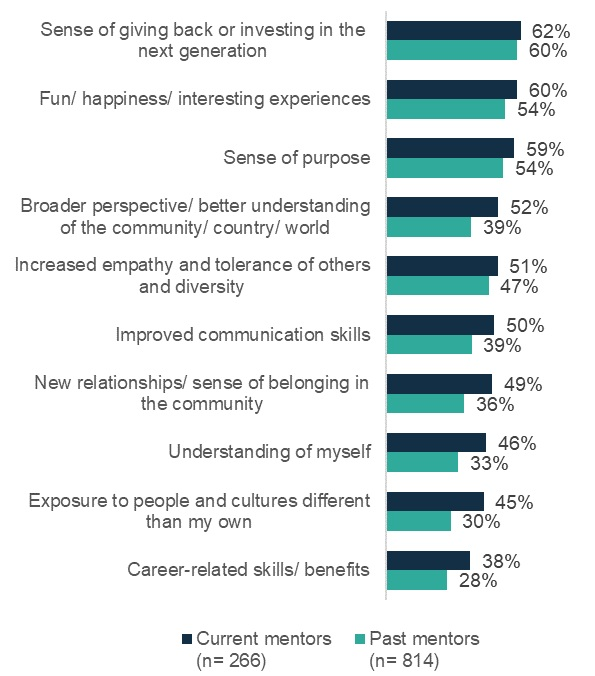
In a Mentor Canada study about adults’ engagement in mentoring youth, respondents confirmed that mentoring relationships are reciprocal. They provided some of the benefits they experienced as mentors (Mentor Canada, 2021).
Alternate text for image on the right:
Sense of giving back or investing in the next generation – 62% current mentors; 60% past mentors. Fun/happiness/interesting experiences – 60% current mentors; 54% past mentors. Sense of purpose – 59% current mentors; 54% past mentors. Broader perspective/better understanding of the community/country/world – 52% current mentors; 39% past mentors. Increased empathy and tolerance of others and diversity – 51% current mentors; 47% past mentors. Improved communication skills – 50% current mentors; 39% past mentors. New relationships/sense of belonging in the community – 49% current mentors; 36% past mentors. Understanding of myself – 46% current mentors; 33% past mentors. Exposure to people and cultures different than my own – 45% current mentors; 30% past mentors. Career-related skills/benefits – 38% current mentors; 28% past mentors.
Current mentors (n=266) / Past mentors (n=814)
MentorAbility mentors share their experiences
The MentorAbility Canada initiative facilitates fully supported, short (from 1 hour to 1 day) mentoring experiences for persons experiencing disability. These mentoring moments offer opportunities for mentees to explore job or career options and to think about their next steps.

Becoming a mentor can be a big decision. We might ask ourselves, “Do I have what it takes to be a mentor?” and “What do I have to share? Is my knowledge needed?” We might also wonder, “What will we do during the mentorship? What will I say?”
To help us better understand the mentor’s experience, two MentorAbility mentors from our national partners kindly shared their thoughts about their mentoring experiences. MentorAbility’s national partners offer mentorships across the country to mentees in any province and territory. They also work with MentorAbility strategically to offer these opportunities to their staff across the country.
Rachel – Stingray Radio
Rachel, who works with our national partner Stingray Radio, recently had a mentorship with Alexis (whose name has been changed for this post). Rachel was drawn to MentorAbility because it offered an opportunity to use her experience to help someone explore career paths and build confidence in the workplace.
“I know firsthand how valuable it is to have someone willing to share their journey, answer questions, and help you see what’s possible.
“I wanted to help provide that same support and encouraging presence for someone who may be facing additional barriers entering or advancing in the workforce. I wanted to share my knowledge with someone exploring their own path. Whether it’s helping them understand different roles, building their confidence, or simply being someone in their corner to talk through challenges, I wanted to be that person.
“I also deeply value that mentorship is a two-way street. While I can share my perspective, I learn just as much from mentees and their unique experiences. The work your (MentorAbility Hub) is doing is incredibly meaningful, and it’s inspiring to see the positive impact we can make together! I believe meaningful connections and open conversations can make a real difference, and I was excited to be part of that.”
Preparing a mentor by providing resources and personal support is an important part of the process and can help to ensure quality mentorships. “I felt very confident and well-supported going into my mentorship thanks to the excellent resources provided. The training and resources were very practical and easy to follow, and I appreciated having access to additional support when needed. Overall, I felt well prepared going into the mentorship!”
“The kickoff call with the (MentorAbility) team was incredibly helpful for answering my initial questions and giving me a clear understanding of what to expect.”
In Rachel’s case, the mentee, Alexis, also provided questions ahead of time. “My mentorship was a virtual conversation. The mentee provided a list of questions beforehand, which was incredibly helpful. It allowed me to prepare and provide as much valuable information and feedback as possible within our scheduled time.”
Thanks to these preparations, Rachel felt prepared and eager for her mentorship. “I was very excited. I wanted to make sure I was prepared and could bring value to the conversation.
“It wasn’t necessarily about having all the answers, it was about being open, supportive, and honest about my own experiences.”
After the mentorship, Rachel emailed the mentee a summary of their meeting and included extra information that might be useful. “Following our call, I sent a recap email with additional resources and information that I thought would be helpful. While we covered most of the questions during the meeting, I wanted to make sure they had clear, written resources to refer back to. This format worked well for both of us because it allowed for a focused, efficient, and flexible conversation.”
Mentorships with mentees who experience disability can help us to understand the importance of workplace inclusion and of being open to new learnings. “The mentorship reinforced for me the importance of creating more inclusive and supportive opportunities, especially for people who may face additional barriers in the workplace. It also reminded me of the value of listening, being open-minded, and learning from others — skills that are important both personally and professionally.”
“I’m grateful to have been part of an initiative that creates opportunities for people to connect, learn from one another, and feel more supported in their career journey.
“I would absolutely love to participate in another MentorAbility mentorship! Sharing my industry experience to help someone build their confidence and navigate their career path is deeply important to me. In a fast-paced industry, having a guide can make a significant difference, and I want to be that supportive resource for someone else.
“This experience was just as valuable for me to learn from the mentee, hear their unique perspectives, and understand the specific challenges they face. It is an incredibly rewarding way to give back, support emerging talent, and actively work toward breaking down barriers to promote true accessibility and inclusion within our workforce.
“I would also love to participate in an in-person mentorship as I believe there is something really valuable about building a connection face-to-face.”
Jill – Insurance Industry
Jill works with one of MentorAbility’s national partners in the insurance industry. She heard about MentorAbility through a colleague in their Diverse Abilities Employee Resource Group (ERG) who shared her experience with a mentorship. “It sounded like it would be interesting and a valuable experience for me to participate in as well.”
Every mentorship is different and is shaped by the needs of both the mentee and the mentor. Jill and the mentee, who lives in a different province, agreed on a virtual meeting for their mentorship experience.
Mentors can feel nervous before their mentorship, sometimes because they want to make sure they offer a valuable experience for the mentee. “I was a bit nervous as I wanted to make a good impression and leave them with a positive experience.”
As a mentor, you may not always know what to say or what to do. For these moments of uncertainty, Jill provides good advice: “I just spoke from the heart and shared personal experiences.”
“I felt good and that I was able to be encouraging about the potential in my organization. I absolutely would participate again!”
To learn how you can become a MentorAbility mentor, please visit the MentorAbility website.
Helpful Tips for Mentors for a Quality Mentorship
Before the mentorship
- Remember that mentorship is a partnership during which both mentors and mentees contribute to and learn from the experience.
- You can ask the mentorship facilitators:
- questions about the process so that you understand how it works and the commitment required
- if they will provide resources and support to ensure you are prepared and feel confident going into the mentorship
- whether the mentee has questions for you and whether these can be provided in advance
- It’s okay to be nervous before the mentorship! The mentee may also be nervous, and that’s a normal reaction.
During the mentorship
- If you’re not sure what to do or what to say, share a story from your professional experience. You can think of a few stories beforehand that might be relevant. You can write the information and bring it with you to help you remember.
- Most importantly, have fun and enjoy the experience with your mentee!
After the mentorship
- If you like, you can ask the mentee if you can send them a summary of your meeting and additional information.
- Write notes about the meeting and the learnings you can take away from it. Reflect on how these learnings can inform your work.
- Share your mentorship story with your employer and colleagues. Focus on your experience while keeping your mentee’s information private.
- Let your mentorship facilitator know if you’re interested in doing another mentorship!
References
Gosh, Rajashi, and Thomas G. Reio Jr. Career benefits associated with mentoring for mentors: A meta-analysis. Journal of Vocational Behavior, Volume 83, Issue 1, 2013, Pages 106-116.
Heron, Laura M. and others. Mentoring Postsecondary Students with Intellectual Disabilities: Faculty and Staff Mentor Perspectives. Education Sciences 13, no. 2 (February 2023): 213.
Mentor Canada. Raising the Profile of Mentoring: Recruiting more Mentors across Canada – Report – The State of Mentoring in Canada. May 2021.
Signal49 Research in collaboration with MentorAbility Canada and the Canadian Association for Supported Employment. Empowering Inclusion in the Workplace: Mentorship Program Toolkit for Employers. October 29, 2025.