
Break the Cycle of Misinformation: Common disability employment myths and how to respond to them
Background image: fujiphilm on unsplash
Break the Cycle of Misinformation:
Common disability employment myths and how to respond
Many people still know little about disability or employment inclusion, and ableism remains a systemic issue in Canada. We list some common myths often raised during conversations and simple, factual responses.
For the French version of this post, please click on “EN” at the top of the page, then select French.
Many people still know little about disability and even less about employment inclusion. Employment inclusion means that all persons experiencing disability have equal opportunity to find, retain, and advance in meaningful, competitively paid employment.
Great advances have been made with disability resources and workplace inclusion. However, according to a 2024 KPMG survey, ableism in the workplace remains a systemic issue in Canada. Ableism devalues and limits the inclusion of persons experiencing disability, while viewing people without disability as “normal” or “the standard.”
The more we share about disability employment, the more normalized it will become.
Everyday conversations in person or online are practical vehicles to share facts about disability and employment. Sometimes, interactions can be challenging when people repeat misinformation and common myths about disability and workplace inclusion.
To improve understanding of disability and employment, below are some common myths and misinformation that are often raised, along with some simple, factual responses.
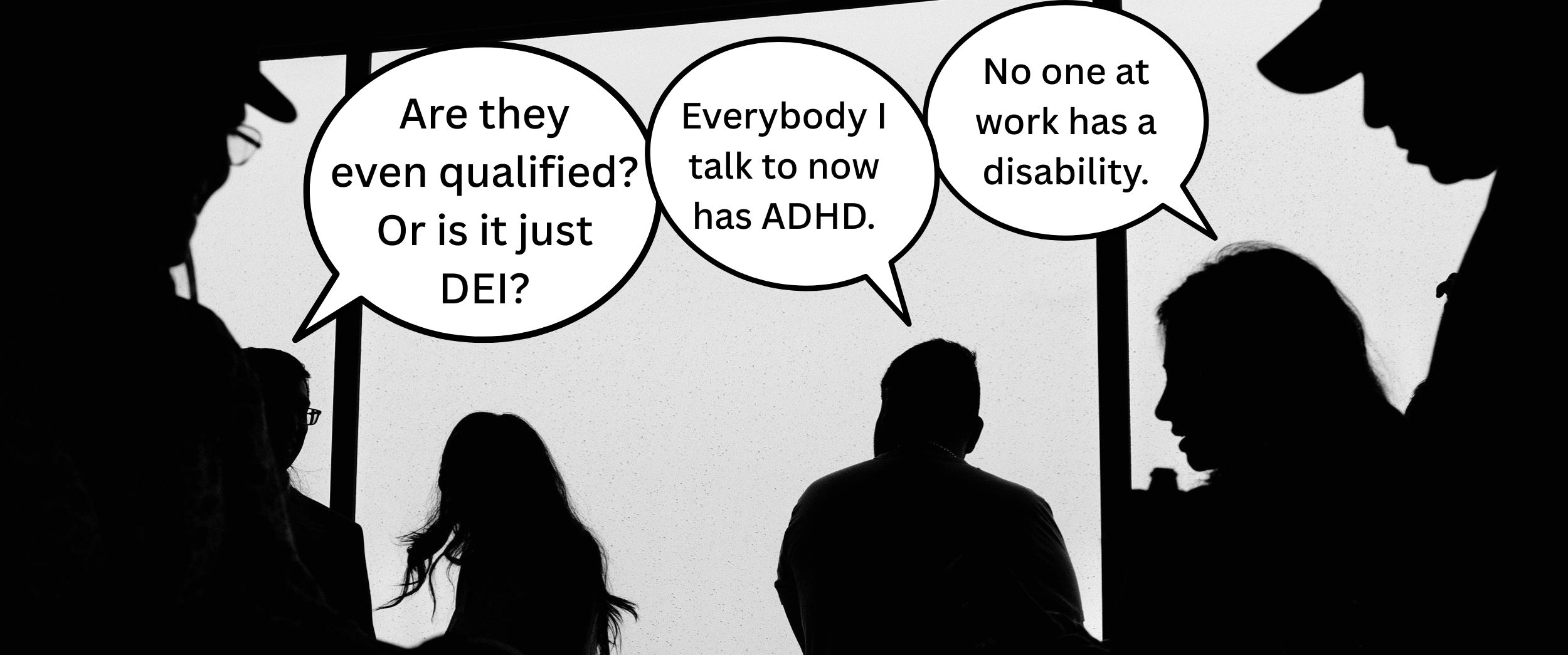
No one in my workplace has a disability.
Can a person who uses a wheelchair do my job?
There are many types of disability, and disability is not always visible or obvious. So, it can be difficult to know how many people in your workplace experience disability.
In fact, the most common types of disability in Canadian workplaces are not apparent (Statistics Canada). They include pain, flexibility, mobility, and mental health challenges. Neurodivergence (like autism, dyslexia, and ADHD or attention deficit hyperactivity disorder) is also not visible.
People who experience disability are just like any other worker. Whether a person has a disability or not, they can apply for and do the jobs they’re interested in and are qualified to do.
Jobs aren't going to the most qualified people anymore.
People are only in those jobs because of DEI (diversity, equity, and inclusion).
I can’t even get a job anymore because of DEI.
Inclusion is not about placing people who experience disability in just any job. It’s about finding a good fit: a job the person is interested in doing and that they have the experience and skills to do. A good fit is important because both job seekers and organizations want people to succeed in their job, whether they experience disability or not.
People who experience disability can encounter barriers while seeking work and while working. The biggest employment barriers are stigma and unconscious bias, mainly due to lack of knowledge about disability. People will often make unfair decisions based on disability rather than ability.
When inclusion is integrated into policies and processes, companies can be more certain than ever they’re hiring the best people for the jobs.
Many companies have learned about disability and have integrated inclusion into their operations. They want to make sure that all people have an equal opportunity to demonstrate their skills and ability to do a job and to advance in their career. The leaders, managers, and staff with these companies spend time learning about the barriers, which plays a big part in reducing them.
When inclusion is integrated into policies and processes, companies can be more certain than ever they’re hiring the best people for the jobs.
Everybody I talk to now has ADHD or something.
In Canada, more than one quarter of people 15 and over (27%) and one in five workers have one or more disabilities (Statistics Canada), which could include many people we speak with every day. Some common disabilities include mental health challenges and neurodivergence, like ADHD and autism.
In the past, there was more stigma and lack of knowledge around disability. People did not talk about disability and many people went undiagnosed. Today, while stigma still exists, more people are learning and talking about disability.
As people’s knowledge of disability grows, so does awareness of their own disability and their willingness to talk openly about it. The more we talk about disability, the more we can understand it.
Accommodations are special treatment that give people unfair advantages.
Accommodations benefit every worker in the organization. Many people will experience disability at some point in their life, especially as the workforce ages, and they may require accommodations to do their job.
An important element of workplace inclusion is simply communicating on a regular basis with all workers to make sure they have what they need to do their job, which is helpful for all workers. The purpose of accommodations is to help an employee perform their job more effectively.
An accommodation can be as simple as enabling captions during a virtual interview, flexibility with work hours or remote work, or creating a step-by-step check list for a specific task. Maybe software or an app can assist with speech-to-text or note taking.
Trusting people and providing the accommodations they need, whether they disclose a disability or not, demonstrates that an organization values workers. When workers feel valued and they receive the support they need, they can be more engaged in their work — and that benefits their entire team and increases workplace morale.
When workers feel valued and receive the support they need, they can be more engaged in their work — and that benefits their entire team.
People with disabilities can only do some types of work.
I don’t think our workers or managers will like training and working with a person with disabilities.
There is a misperception that “disability” means “lack of ability” or that a person experiencing disability could not perform a job. In fact, the greatest lack is knowledge about disability and workplace inclusion by many employers, managers, and employees.
Persons who experience disability have diverse interests, education, skills, and work experience, just like everyone else. They are workers like every other worker and are treated the same as other employees.
One in five workers in Canada has some form of disability (Statistics Canada), which means that persons experiencing disability are already in roles at all levels and in various workplaces across the country.
It’s important for all leaders, managers, and staff to receive training about disability and workplace inclusion, and for those who are hiring and managing workers to remain open to ongoing learning. The Employers page and the blog on the CASE website are good places to start to learn more about disability and employment.
I treat everyone in my workplace the same. We’re all equal here.
Employment equity is not about treating everyone equally. Equity is about acknowledging that persons who experience disability and who may have other identities (Indigenous, Black, gender diverse, immigrant, or others) have different employment experiences than our own. People who experience disability face unique challenges and barriers that can cause them to experience trauma and chronic stress.
Carissa Gravelle, facilitator for CASE’s certificate program, An Intersectional Approach to Supporting Career Development, compares treating everyone equally to running a race. “It’s like giving a team of 10 people a size 5 shoe and expecting them to all win the race. I don’t know how many people could win that race. A few people might have an advantage and others would be disadvantaged.”
Ongoing learning about disability and diversity can help us understand some of the barriers that can impact job seekers and workers.
While there may be individual incidents of discrimination, systemic discrimination doesn’t exist anymore in Canada.
Systemic discrimination is still prevalent in Canada. A 2024 KPMG survey found that 60% of employed Canadians with disabilities were searching for a new job due to feelings of underemployment and ableism in their workplace.
A recent survey with working-age adults from across Canada experiencing disability (Signal49 Research, 2025) found that stigma shows up at the workplace as negative attitudes, unfair treatment, and assumptions about what individuals can and can’t do.
In 2024, 60% of employed Canadians with disabilities were searching for a new job due to feelings of underemployment and ableism.
Many survey participants who requested accommodations had their requests denied or faced consequences, like stigma or retaliation. When persons with non-apparent disabilities disclosed, they experienced either a lack of sensitivity or outright rejection.
Discrimination can be unintentional. In some workplaces, employment policies and processes may not take into consideration the needs of job seekers and workers experiencing disability. Everyone has unconscious biases that can contribute to unfair treatment. Even when unintentional, multiple instances of discrimination can leave persons experiencing disability with chronic stress, mental health challenges, and feelings of exclusion.
Education about disability and workplace inclusion can support employers and staff to recognize ableism, unconscious bias, and discrimination and to learn how to build workplaces that are safe and engaging for all workers.