

Accessible Workplaces Engage All Workers
Accessible Workplaces Engage All Workers
Inclusive workplaces strengthen worker engagement—attracting and retaining skilled workers and enhancing organizational resilience.
For the French version of this post, please click here.
Pour la version française de cet article, veuillez cliquer ici.
December 3 is International Day of Persons with Disabilities. Four million persons in Canada experience disability and contribute to the success of workplaces around the country.¹
Creating inclusive and accessible workplaces where all workers feel heard and engaged is essential for businesses focused on attracting and retaining skilled workers and enhancing organizational resilience.

(Credit: Professional in a Virtual Meeting @ Jordon Nicholson/Disability:IN – CC BY-ND 4.0)
Most People Will Experience Disability in Their Lifetime
One in five workers over 15 years of age in Canada experiences some type of disability.¹ Workers who experience disability are in every sector, from entry-level to leadership positions.
Most people will experience disability at least once in their lifetime. According to Statistics Canada, the most common disabilities include pain, flexibility, mobility, and mental health challenges, which can affect many people.²
The most common disabilities include pain, flexibility, mobility, and mental health challenges, which can affect many people.
Stigma and Ableism Still Widespread
Research shows that stigma and ableism toward disability remain widespread in Canada. The Canadian Association for Supported Employment (CASE) conducted a public sentiment analysis of discussions around disability and employment on major Canadian social media platforms in early 2025.³
A dominant theme was widespread experiences of negative attitudes, bias, and stigma toward persons experiencing disability. Many social media users experiencing disability described being dismissed, doubted, or unfairly judged during hiring processes, with workplace accommodations, or in how others perceive their abilities.³
I was passed over for a promotion—again. I’ve been at my job for five years. I have the same qualifications as my colleagues, I meet my deadlines, and I take on extra work. But when a leadership position opened up, my manager told me, ‘We just don’t think you can handle the extra responsibility with your condition.’
Facebook user, quoted in Understanding Public Sentiment on Disability and Employment through Social Media Analysis
More Recruitment and Workplace Barriers — Even When Qualified
Persons experiencing disability, even when they’re as qualified as other candidates, face more recruitment and workplace barriers. According to Statistics Canada, nearly three in five (59%) persons with disabilities experienced barriers related to accessibility in the labour market.4
The most common barriers included challenges disclosing their disability, difficulties with accommodations, and a lack of support or respect from hiring staff or past colleagues and managers.4
I remember the first time a hiring manager looked at me and saw only my wheelchair. It wasn’t my years of experience, my degrees, or the fact that I was more than qualified for the job. It was the wheelchair, my Blackness, and the assumptions that came with both.
Facebook user, quoted in Understanding Public Sentiment on Disability and Employment through Social Media Analysis
Like other employers, accessible workplaces select candidates based on their qualifications, skills, and experience. They also offer candidates the option of accommodations during the recruitment process, because every person’s lived experience is different.
Most Accommodations Simple and Low Cost
Statistics Canada found that 35% of employed people with disabilities needed at least one workplace accommodation, most of which cost little to nothing. The most common accommodations were modified work hours, modified or different duties, working from home, modified or ergonomic workstation, or a special chair or back support.4
All employees should be informed about accommodations. Accommodations are not an unfair advantage or special treatment. They are supports that help to level the uneven playing field in workplaces that are not traditionally designed for every worker.
Per Statistics Canada, 35% of employed people with disabilities needed at least one workplace accommodation, most of which cost little to nothing.
Inclusive, Accessible Workplaces Reduce Need to Disclose
Disclosing a disability can be a difficult and complex decision, not least because of stigma and discrimination. Fostering environments where employees feel safe to disclose is important.
Recent research by CASE and The Conference Board of Canada found that reducing the need to disclose altogether has an even greater impact.5 When accessibility and inclusion are embraced by leadership and are embedded in policies, physical spaces, technologies, and workplace culture, all employees can access support as needed, without having to disclose.
CASE Employer Partners on the Importance of Workplace Accessibility and Disability Inclusion
CASE partners with employers for the Abilities at Work Advisory Team and for MentorAbility Canada, a national inclusive mentoring initiative. MentorAbility Canada, which is funded in part by the Government of Canada’s Opportunities Fund for Persons with Disabilities, brings together persons experiencing disability and mentors for transformational short (one hour to one day) mentorship experiences.
Employer partners are dedicated to strengthening accessibility and disability inclusion in their workplaces, each in a way that works for their business.
Stingray
When our creators, curators, and producers reflect the diversity of our global audience, our programming becomes more authentic, relatable, and resonant, allowing us to connect with listeners in a more meaningful way. When you build an accessible environment where every voice is empowered to contribute, you unlock a level of innovation and market connection that a homogenous team simply cannot achieve.
Established networks and conventional career paths can create invisible barriers for talent from underrepresented groups. Mentoring highlights the need to be more intentional about creating clear pathways for connection and contribution, ensuring that diverse voices are not only present in the room but are also heard, valued, and empowered.
Jane Krindle, Senior Director, Human Resources – Radio, Stingray

Mentors and mentees at Stingray Radio Newfoundland.
(Credit: Stingray Radio Newfoundland)
Sun Life Canada
We prioritize inclusion and belonging because we understand that a diverse workforce powers innovation and creativity. As an employer, we play an important role in making sure our people have the support needed to thrive at work. Our approach is holistic, encompassing stay-at-work strategies, supported return-to-work plans, and tailored accommodations. We’re particularly proud of our assistive technology hub built in partnership with our Digital Accessibility Centre of Excellence.
Katrena Munsch, Director, HR Benefits and Well-Being, Sun Life Canada
EY Canada
At EY we know that diverse teams are high performing teams, best positioned to solve today’s most complex business and innovation challenges. By embedding accessibility into our tools and practices, we empower all employees not just to perform their duties but to thrive and enhance our collective performance.
Efficient accommodations processes that employees can clearly navigate are essential to any business. However, each request represents an opportunity to ask how we might inclusively design. Embracing inclusion is the foundation for cutting edge innovation and success in today’s dynamic world, where we never know what kind of advanced processing or resilience will be needed next.
Tammy Morris, Accessibility & Neuroinclusion Leader, EY Canada
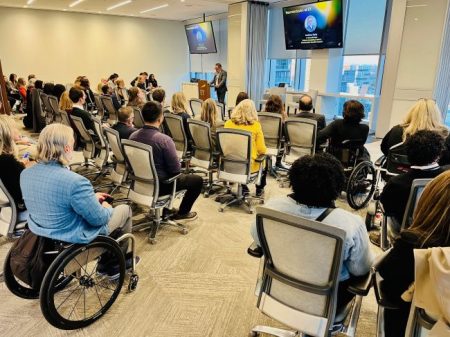
EY staff and clients gathered in Toronto office to share stories and insights to celebrate National Disability Employment Awareness Month (NDEAM).
(Credit: EY Abilities Network)
auticon Canada
When neurodivergent or disabled employees face barriers at work, it’s often a signal of broader issues affecting everyone. By addressing these early indicators and applying universal design principles, businesses can create workplaces that work better, for every employee.
Ali Dussault, Senior Director of Operations, auticon Canada
Start Now to Learn about Disability and Workplace Barriers
- Acknowledging that disability can be in your workplace, even if you can’t see it.
- Learning about disability in the workplace and the barriers that make it harder for persons experiencing disability to get hired, stay in jobs, and advance in their careers.
When workplace accessibility and inclusion are embedded within organizations from recruitment to advancement, everyone benefits. Workers feel heard and can be more engaged, which can attract and retain skilled workers and enhance organizational resilience.
Resources for Employers
Businesses interested in exploring workplace accessibility and inclusion can access complimentary resources, short online courses, MentorAbility - an inclusive mentoring program, an HR policy toolkit, and more on the CASE website.
Find an Employment Service Provider
You don’t have to take this journey alone. A supported employment service provider can help you assess your needs, access hidden talent, support you from hiring to onboarding, and more.
References
- Statistics Canada. Labour force status of persons with and without disabilities aged 15 years and over, by age group and gender. Released December 3, 2024. Released December 3, 2024.
- Statistics Canada. Canadian Survey on Disability, 2017 to 2022. Released December 1, 2023.
- Canadian Association for Supported Employment. Understanding Public Sentiment on Disability and Employment through Social Media Analysis. March 2025.
- Statistics Canada. Accessibility barriers related to employment among persons with disabilities or long-term conditions, 2024. Released February 10, 2025.
- The Conference Board of Canada and CASE. Disclosure and Inclusive Mentorship for Adults Experiencing Disability. 2025.