

CASE Member Spotlight – Inclusion Powell River
CASE Member Spotlight
Inclusion Powell River

The Canadian Association for Supported Employment (CASE) is committed to facilitating inclusive employment in Canada for persons experiencing disability and who may have intersecting identities. Our work is guided by our values and the guiding principles of supported employment. This work also involves learning and promoting best practices in Canada and across the world with the shared goal of advancing supported employment.
Kateryna Zmytrovych, CASE Member Experience Coordinator, spoke with the following staff members at Inclusion Powell River:
- Staci McClure, Employment Services Coordinator
- Chantal Edmunds, Employment Consultant
- Christine Townley, Employment Consultant
Please introduce your organization.
Staci: We are Inclusion Powell River, a non‑profit organization dedicated to supporting people with developmental disabilities across the lifespan to live full, meaningful, and self‑determined lives. Among its 13 programs and services, Employment Services plays a key role in helping youth and adults prepare for, secure, and maintain meaningful work.
Our service offers customized employment, individualized job search support, skill‑building opportunities, and job coaching, all tailored to each person’s strengths and goals. By partnering with inclusive local employers and building strong, small town community connections, Employment Services helps create sustainable employment opportunities that promote independence, confidence, and long‑term success.
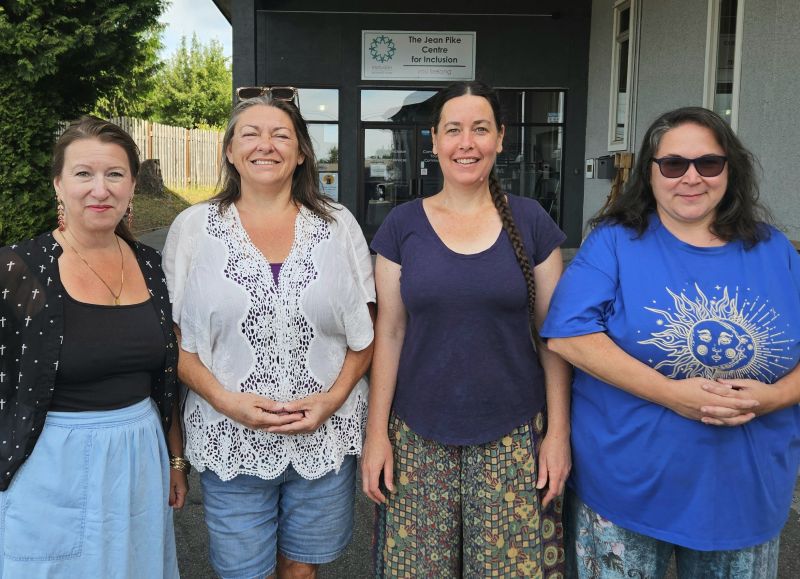
Photo above – from left to right: Staci McClure, Employment Services Coordinator; Chantal Edmunds, Employment Consultant; Sasha Pugsley, Vocational Counsellor; Christine Townley, Employment Consultant. (Credit: Inclusion Powell River)
Chantal: Our role is to do whatever is needed to make employment successful and sustainable for both our job seekers and employers. A lot of that work happens behind the scenes. I always tell employers that hiring someone through our program does not mean our support ends — we continue working closely with both the employer and the job seeker to ensure a successful fit. We focus on tailoring positions to each person’s skills, abilities, and interests, which is one of our primary goals.
What’s a recent initiative or idea your organization is exploring that excites you?
Staci: This is a very new initiative, and we’re still in the early planning stages, for a skill building group for participants interested in exploring self employment. The group will focus on foundational life and employment skills while guiding participants through the process of creating a small pop up venture.
The pop-up will be showcased at a local farmers’ market or street festival. Participants will learn practical, transferable skills, take part in each step of planning and launching the pop-up, and collectively choose the product or service they want to offer.
Entrepreneurship is often overshadowed by traditional community employment, even though for many people it can be the best fit or already a personal goal. This group will aim to provide a low risk way for individuals to “test the waters,” gain confidence and experience what it’s like to build something from the ground up through to completion. It’s an opportunity to explore creativity, independence, and meaningful work in a supportive, hands on environment.
Kateryna: As you move forward with the program, please feel free to share any updates with CASE. Whether you’re launching a new initiative or testing a new approach, we welcome hearing about what you did, what worked, and what you learned. We can help circulate those experiences through our networks, so others can benefit from your knowledge and insights.
“The pop-up will be showcased at a local farmers’ market or street festival. Participants will learn practical, transferable skills, take part in each step of planning and launching the pop-up, and collectively choose the product or service they want to offer.”
Can you share a moment when you saw the impact of your work firsthand?
Chantal: One example that stands out is a gentleman I worked with a few years ago. We started by helping him secure a position at a local car dealership, where his first task was pulling weeds in the parking lot.
Today, four years later, he works there full-time, has earned his driver’s licence, and is responsible for moving and detailing vehicles. He has purchased two new vehicles of his own, and his next goal is to become a car salesperson. What began as a simple landscaping task has transformed his life, increasing his independence, confidence, and financial stability.
The employer has been fantastic throughout the process. We worked closely with them to support his success, and I still check in periodically. Seeing how proud he is of what he has accomplished has been incredibly rewarding.
Another success story involves a gentleman who was delivering newspapers in all kinds of weather and doing a small weekly cleaning job, dusting doorknobs and windows at an office. After working together for a couple of years, he secured employment with a large local grocery store, where he has now worked successfully for several years.
The job has given him greater independence. He moved into a new apartment and is able to do things he had always wanted to do, like travelling to Vancouver Island to take his brother out for lunch. Again, a supportive employer made all the difference. They were open to workplace accommodations and embraced his unique communication style. Today, he is thriving and well respected at work.
Christine: One of my proudest moments involved a job seeker who faced multiple barriers to employment. Finding the right fit was challenging, but eventually we found a workplace where he could succeed.
What makes this story especially meaningful is that the employer began embracing customized employment on their own. The last time I checked in, the employee had taken on a new role creating artwork for pizza boxes — something completely unrelated to the position he was originally hired for.
His employer noticed that he had a talent for it and proactively customized part of the job around his strengths. Seeing an employer recognize someone’s abilities and adapt the role without any prompting from us was incredibly rewarding.
Staci: Beyond individual success stories, we are also seeing positive change on a broader scale. More employers, including large corporations, are beginning to recognize the value of inclusive hiring.
A particularly exciting example happened about six months ago when a new grocery store was preparing to open in our community. Instead of us approaching them, they reached out to us and expressed a desire to hire inclusively.
That was a major milestone because employment service providers usually initiate those conversations, especially with larger companies. The partnership resulted in the store hiring four of our job seekers.
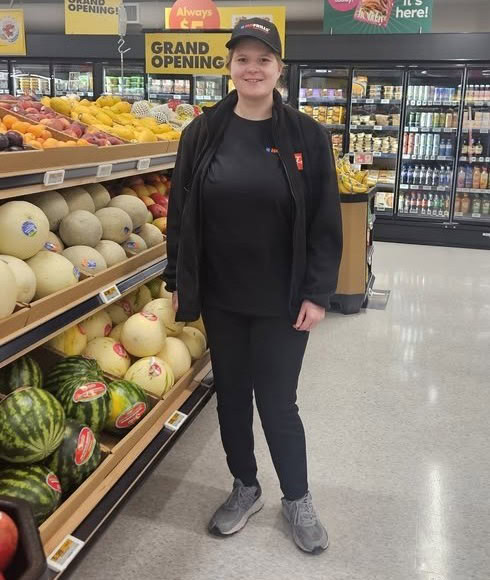
A new grocery store hired four Inclusion Powell River job seekers. (Credit: Inclusion Powell River)
How do you collaborate with partners or the community to strengthen your impact?
Staci: Inclusion Powell River has had a few name changes over the years, but we have been in operation since 1954, 73 years and counting. We are lucky to have a large community presence and familiarity. Employment Services is well known to established employers and is always initiating relationships with new businesses. Employment Services has hosted job fairs and employer recognition events and attends community events and groups.
We work closely with other agencies offering support to people with barriers to employment, youth transitioning into adulthood, the school district, and our local university. This outreach ensures anyone who wishes to find employment can access our service.
Chantal: Building relationships with employers is a huge part of what we do. We spend a lot of time reaching out, meeting employers, and helping them understand the benefits of inclusive hiring. Sometimes that means literally going door to door, introducing ourselves, and starting conversations with local businesses.
How has your work influenced the way you think about inclusion?
Christine: This work has taught me that inclusion is about looking at the person and all the interconnected parts of their life. It’s not just about whether someone has a job. You have to consider whether they have stable housing, enough to eat, healthy relationships, and the supports they need both at work and in their personal lives.
It has also reinforced the importance of thinking outside the box. Supporting people into employment often requires creativity, problem-solving, and exploring opportunities that might not be obvious at first. Every person is different, so there is no one-size-fits-all approach to inclusion.
Another key lesson has been the importance of relationships. Building trust and understanding from the very beginning is often the foundation for success. Whether it’s with the job seeker, the employer, or other supports in a person’s life, strong relationships are an essential part of creating truly inclusive opportunities.
Staci: My understanding of inclusion has evolved to recognize that it’s not a single action or a statement on a door saying everyone is welcome. True inclusion requires ongoing effort, reflection, and a willingness to learn.
It also requires people to be open to making mistakes. Inclusion is a process, and it’s better to take steps toward being more inclusive — even if you do not get everything right the first time — than to avoid trying altogether. The most important thing is having the willingness to listen, ask questions, and keep learning.
“You have to consider whether they have stable housing, enough to eat, healthy relationships, and the supports they need both at work and in their personal lives.”
What advice would you give to someone who wants to contribute to more inclusive communities?
Staci: There are many resources available for people who want to learn more about inclusion, including assessment tools, guides, and resources for employers and community organizations. However, the best place to start is by talking to people who are already doing this work and, most importantly, listening to people with lived experience.
Inclusion begins with curiosity and a willingness to ask questions. The more we listen and learn from others, the better equipped we are to create welcoming and accessible environments.
Christine: One thing I always emphasize is treating people like people. While it is important to understand and accommodate individual differences, it is equally important not to view people solely through those differences. Everyone wants to be treated with respect, dignity, and the same sense of belonging as anyone else.
Chantal: Don’t be afraid to make mistakes. Inclusion is a learning process, and mistakes are opportunities to learn and improve. Instead of asking, “Whose fault is this?” ask, “What can we learn from this?”
Inclusion requires people to step outside their comfort zones, try new things, and be open to growth. A big part of our work is helping people turn employment from an abstract idea into something concrete.
We help them understand what work looks like, feels like, and sounds like, and we break down the steps needed to get there. By making opportunities achievable, we help people build confidence and see themselves as part of the workforce and the community.
Advice for people wanting to contribute to inclusion
Inclusion begins with curiosity and a willingness to ask questions.
Listen and learn from others.
Treat people like people.
Don’t be afraid to make mistakes. Inclusion is a learning process.
When a mistake is made, ask, “What can we learn from this?”
Is there anything else you would like to add?
Staci: We also have a question: where is the conference being held next year? We weren’t able to attend this year but are curious about the next one.
Kateryna: We are excited to share that the 2026 Annual National Supported Employment Conference is going to be in St John’s, Newfoundland and Labrador, hosted by CASE in partnership with Avalon Employment. We hope to see you there!
For more information about Inclusion Powell River, visit their website.