
CASE Member Spotlight – Inclusion Langley Society
CASE Member Spotlight
Inclusion Langley Society
The Canadian Association for Supported Employment (CASE) is committed to facilitating inclusive employment in Canada for persons experiencing disability and who may have intersecting identities. Our work is guided by our values and the guiding principles of supported employment. This work also involves learning and promoting best practices in Canada and across the world with the shared goal of advancing supported employment.
Kateryna Zmytrovych, CASE Member Experience Coordinator, spoke with the following staff members at Inclusion Langley Society:
- Vicky Dawe, Director of Employment and Community Inclusion Services
- Tami Logan, Supervisor of Employment Services
Can you tell us about your organization and the impact you strive to make in the community?
Vicky: Inclusion Langley was founded in 1959 by a group of families who had children with disabilities and recognized that there were not a lot of opportunities for inclusivity in schools and in the community. From the beginning, we were focused on advocacy, basic support needs, and making sure individuals with disabilities had a place in their community, were acknowledged by their community, and were accepted just like anybody else.
One of the big things for us is that we’re never, ever satisfied with what we have in place. We are always seeking input from our families and from the individuals we support so that we’re always looking at what is needed for the future.
Over the last decade, we have expanded beyond what were considered traditional services, where someone might attend a program from “9 to 3” and participate in activities, like bowling or swimming. While those activities are great for some people, we wanted to expand into so much more.
We look at how we can support people throughout the continuum of life. We always have the perspective that while a person’s service may look one way today, tomorrow it could look very different, because it should be based on the needs and wants of that individual.
Today, we continue to focus on evolving our services to meet the changing needs of our community. We are experiencing significant community growth, including many new immigrant families, and it is important to us that we learn from and understand those different cultures and perspectives. We believe every community and culture brings value and helps us grow, evolve, and become something we may not have even envisioned before having those conversations.
Tami: At Employment Services, our goal is to create a community where everyone has the opportunity to participate in meaningful employment. We support job seekers with diverse abilities to find jobs that match their strengths, interests, and goals, while also working closely with employers to build more inclusive workplaces.
The impact we strive to make goes beyond simply helping somebody find a job. We want job seekers to feel valued, included, and confident in their abilities. At the same time, we work to raise awareness within the business community about the many skills, talents, and gifts that people with disabilities bring to the workplace.
By partnering with employers, we provide education and challenge misconceptions. We’re helping create a community where inclusion is the expectation, not the exception. When employers embrace inclusive hiring, everyone benefits: businesses gain dedicated employees, individuals gain independence and purpose, and the community becomes stronger, more diverse, and more welcoming for all.
“A big part of our approach is that we’re not afraid to take risks, because we believe that with risk comes learning.”
Vicky: A big part of our approach is that we’re not afraid to take risks, because we believe that with risk comes learning. Many people tend to run away from failure, but we don’t really perceive it as failure. We believe there’s always something positive that comes out of an experience, even if it doesn’t take us in the direction we originally expected.
If something doesn’t work out the way we planned, it often leads us in a different direction, and there’s always something valuable we can learn from it. We take those lessons and transform them into something new and try again.
What is a current project, program, or initiative that your team is especially excited about?
Vicky: One initiative we’re especially excited about is a program called Link, for which we’ve recently secured funding for a full-time staff position, although we know it will continue to need additional support as it grows.
The idea behind Link came from recognizing a gap between our traditional community inclusion services and fully independent services. Traditional services are typically structured around a one to three staff-to-participant ratio, where individuals attend community activities, volunteer opportunities, events, or sometimes employment with staff support. However, we found that some people were too independent for that level of structure, while not yet ready for fully independent services where they would manage and request supports entirely on their own.
To address that need, we developed a hybrid service model. Participants receive some structured support while also having the flexibility to request more individualized assistance to help them continue building their independence. It creates an important middle ground for people who need more support than independent services provide but less than traditional programs.
“Participants (in Link) receive some structured support while also having the flexibility to request more individualized assistance to help them continue building their independence. It creates an important middle ground for people who need more support than independent services provide but less than traditional programs.”
Link also helps families feel more comfortable with risk-taking, because there is still a level of structure and guidance in place. Through the program, individuals learn practical life skills, such as staying safe in the community, making appointments, and working toward personal goals.
We piloted the program and it was so successful that it reached full capacity within about a month of becoming an established service. There is now a waitlist, and we’re continuing to advocate for more resources, because many people fall into this middle range of support needs.
Another area of focus is housing and independent living. Because affordable and appropriate housing can be extremely difficult to access, we’ve started a project where families create suites within their homes and we provide independent living supports there. This allows individuals to gradually build the skills they need for independent living in a familiar environment, with the goal of eventually transitioning into their own home as their confidence and abilities grow.
“Because affordable and appropriate housing can be extremely difficult to access, we’ve started a project where families create suites within their homes and we provide independent living supports there.”
Can you share a story that illustrates what inclusion looks like in action and why it matters?
Tami: For me, inclusion is often witnessed in the small but powerful moments. I’ve been doing this work for almost 38 years, with 36 years in employment services, and I still get excited when someone shows us the first paycheck they’ve ever earned. We celebrate when a job seeker lands their dream job, and it’s just as exciting when someone proudly shows up with a brand new car they were able to buy with money they earned themselves.
Inclusion in action is about employers recognizing someone’s abilities instead of focusing on their disabilities. It’s about giving job seekers the opportunity to demonstrate what they can do and having coworkers welcome them as part of the team, whether that’s including them in everyday workplace activities or inviting them out to social events.
I love the saying that “diversity is being invited to the dance, but inclusion is being asked to dance,” because it captures the difference so well. Inclusion is about genuine participation and belonging.
When people feel included, everyone benefits. Individuals gain confidence, independence, and a sense of achievement. Employers gain dedicated and valuable employees. And the community becomes stronger, because everyone has the opportunity to participate, contribute, and be part of the amazing community we live in.
After all these years, it never gets old. I still get goosebumps when people achieve their goals and it’s so clear what becomes possible when they’re given the opportunity to succeed.
Looking ahead, what is one opportunity or challenge for creating more inclusive communities?
Vicky: One of the biggest challenges we recognize looking ahead is the current economic environment and what it means for inclusive employment opportunities. It’s a really challenging time for funding, and we’ve also experienced significant changes in the job market. Our employment team has been incredibly committed, but it has become much more difficult to secure jobs for individuals with disabilities than it was in the past.
There are a number of factors contributing to this. Some businesses are closing or struggling because of the economy, and employers are also placing greater demands on employees. While increases in minimum wage are important and necessary, there can be unintended consequences for some of the individuals we support, as employers often expect more from fewer workers.

Our concern is what this means for inclusivity. We have to ask ourselves whether we’re at risk of losing some of the progress that has been made. That’s always going to be part of our fight, making sure that people with disabilities are not forgotten and that their talents continue to be recognized. The individuals we support are extremely talented, and we witness that every day.
Whether it’s employment opportunities or community participation more broadly, we need to continue advocating for a community that is diverse, inclusive, and committed to recognizing everyone’s contributions and abilities.
Tami: Looking ahead, one of the biggest opportunities is making sure that inclusion is not just a conversation but something that is built into the fabric of our workplaces, businesses, and everyday communities. The goal is for inclusion to become a natural part of how communities operate, rather than something that needs special attention or explanation.
We’re making a conscious effort to be out in the community, attending markets, events, and community gatherings almost every weekend, to spread awareness and keep the conversation going. The encouraging thing is that it’s catching on. More people are embracing the idea that inclusive communities benefit everyone, and we’re encountering growing support for making inclusion an everyday expectation rather than something out of the ordinary.
“We’re making a conscious effort to be out in the community, attending markets, events, and community gatherings almost every weekend, to spread awareness and keep the conversation going. The encouraging thing is that it’s catching on.”
What's a small moment at work that never fails to make you smile?
Vicky: For me, the most wonderful thing about this job is the people. You can be having the worst day, come into one of our services, and be greeted by individuals with huge smiles. They’re so engaging, so genuine, and so real. There’s a sincerity to them that is incredibly special.
What always makes me smile is being able to sit down and have a conversation where there is no judgment, no expectations, and no hidden agenda. They simply want to spend time with you, talk with you, and connect with you.
There’s something really beautiful about those moments. It’s just two people being genuine with one another, enjoying each other’s company, and sharing a real connection. No matter what kind of day you’re having, those interactions can completely change it and remind you what truly matters.
“It’s just two people being genuine with one another, enjoying each other’s company, and sharing a real connection.”
Tami: Honestly, just coming to work makes me smile. I have an amazing team that is so passionate about the work they do, and that energy is contagious.
One of my favourite moments is when someone gets their first job, especially when they’re 40 years old or older, and proudly comes in to show us their first paycheck. Then, they go back to their community inclusion program and share that excitement with everyone else. It creates a ripple effect, inspiring others and getting them excited about what might be possible for themselves.
What makes this work so meaningful is not just witnessing people achieve their goals but also realizing how much they impact us in return. Working alongside the individuals we support has opened up my life in so many ways.
Viewing things the way they view them gives you a different perspective and a deeper appreciation for what really matters. Those experiences, the enthusiasm, and the genuine joy people feel when they succeed are moments that never stop making me smile.
For more information about Inclusion Langley Society, visit their website.
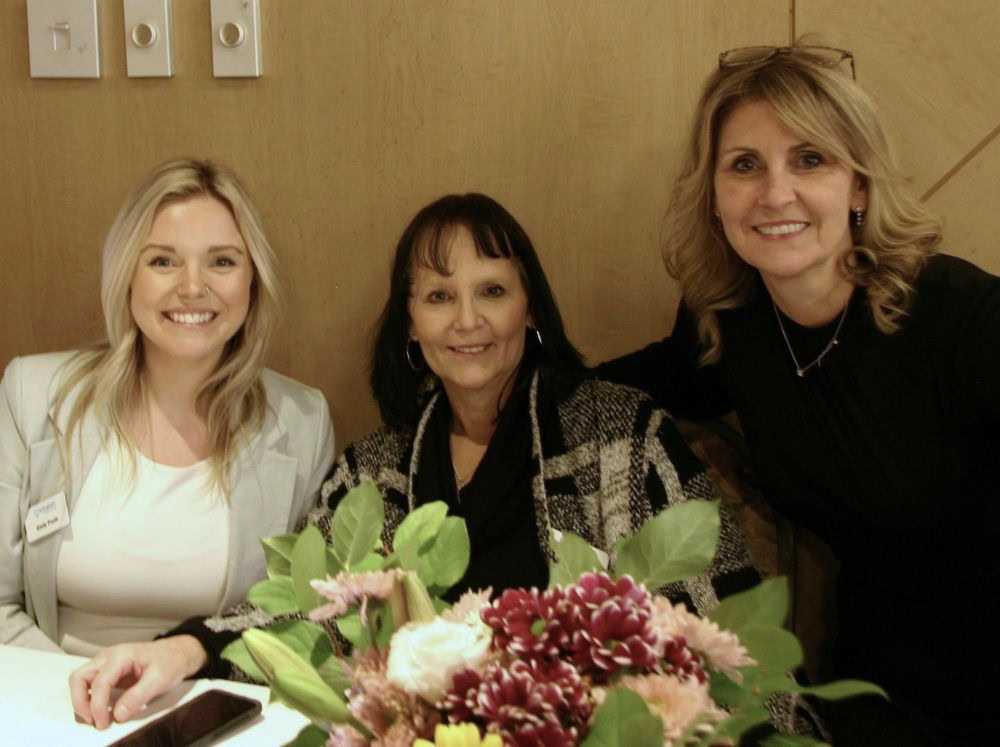
Photo above: Tami (middle) and Vicky (on the right), during NDEAM. (Source: Inclusion Langley Society)