

Neil Squire and CanAssist: Innovative, customized assistive devices and technologies
Neil Squire and CanAssist:
Innovative, customized assistive devices and technologies for work, school, and home
Some of the barriers faced by persons experiencing disability at home and at work can be resolved by integrating assistive technology into daily tasks and activities. However, navigating the world of assistive technology can be daunting, and purchasing it can be expensive.
In Canada, two organizations can help persons experiencing disability, their support teams, and employers to assess a person’s needs, identify solutions, and help find affordable options. Read more about Neil Squire Solutions and CanAssist below.
Jump to:

Neil Squire Society
CASE member Neil Squire is a national not-for-profit organization that empowers Canadians with disabilities through computer-based assistive technologies, research and development, and employment programs.
The Society has been on the cutting edge of technology since 1984. It started in the early 1980s when founder Bill Cameron engineered a sip and puff machine for communication for Neil Squire, a 21-year-old university student who had become a brain stem tetraplegic after a car accident.

Neil Squire Solutions
Neil Squire Solutions is a consultation branch operating under Neil Squire. Their multi-disciplinary healthcare professionals provide assistive technology and ergonomic solutions to enable people to access technology more effectively and to participate more fully in daily activities at work, school, and home.
Their offices are located in British Columbia, Saskatchewan, Ontario, and New Brunswick, and services are available in English and French. Virtual services are available anywhere in Canada.
Services are offered on a fee-for-service basis, with revenues supporting the not-for-profit programs at the Neil Squire Society.
“Our team takes a holistic approach to providing services, where we consider each individual’s functional abilities, tasks, and environment to identify solutions to the challenges encountered. In many cases, solutions can be easily implemented and a little bit of technology can lead to a lot of independence.”
Eric Chau, Occupational Therapist at Neil Squire Solutions
Watch this video to learn how Neil Squire Solutions can help workers find the most effective individualized solutions to workplace barriers.
Individuals and service providers
Neil Squire works with service providers and individuals to help people stay in or re-enter the workforce with suitable workplace accommodations. Accommodations may involve workstation modifications, changes to work habits, and ergonomic or assistive technology supports tailored to address an individual’s specific needs.
Employers
Consultation services are available to meet employees’ workplace ergonomics and accommodation needs. Services include preventative ergonomics presentations, one-on-one assessments for employees with specific work-related barriers, and developing a process for requesting workplace accommodation supports.
How it works
- An assessment is conducted to evaluate the client’s functional needs and their specific work tasks.
- Equipment trials and evaluations ensure the recommended assistive technology meets the client’s specific needs and is compatible with existing equipment.
- Comprehensive reports are provided with recommendations for equipment and service accommodations.
Consultation services are available to meet employees’ workplace ergonomics and accommodation needs. Services include preventative ergonomics presentations, one-on-one assessments for employees with specific work-related barriers, and developing a process for requesting workplace accommodation supports.
Equipment setup and assistive technology training
Neil Squire Solutions can provide setup services to ensure that equipment is set up ergonomically and according to the individual’s needs. Setup can be completed in person or through virtual guidance.

Informational presentations and individual and group training, in person or virtual, are available for different types of assistive technology. Assistive technology devices and products, such as speech recognition software, one-handed keyboarding, switch access, automation tools, and low vision products, often require training to be successfully implemented into daily tasks.
For more information and to contact Neil Squire Solutions, visit their website.
Makers Making Change
Assistive technology can be expensive, so open-source assistive solutions built by volunteers help to make it more affordable. Neil Squire’s Makers Making Change program is an exciting innovative initiative that leverages the lived experience of people with disabilities, the knowledge of clinicians, and the skills of volunteer makers to offer affordable assistive technology.
By early 2026, Makers Making Change had built over 30,000 assistive devices since the program started in 2016. Today, their online library contains over 200 open-source assisted devices with files you can download to build your own. If you can’t find what you need, you can submit an idea and work with a volunteer to build it.
Clubs That Care micro-grants support youth leaders aged 15-30 to engage a group of community volunteers in building assistive devices for people in need in their community.
- 30,000+ assistive devices built
- 200 open-source assisted devices anyone can download
You can learn more about Clubs That Care by attending their Talk To Us Tuesday virtual event on September 15, 2026 at 3:30 p.m. Pacific Time.
You can check all the Makers Making Change programs on their website.
CanAssist
CanAssist, a community-based organization located at the University of Victoria in British Columbia (BC), is committed to innovative, accessible, and inclusive design of assistive devices and technology across BC and Canada and internationally.
They work with all ages and abilities and in English and French, and adapt to people’s evolving needs to promote access, inclusion, and independence.
Their team collaborates with persons experiencing disability, families, professionals, and employers on customized solutions for employment, education, and health and wellbeing. Since 2008, they have delivered more than 2,700 assistive devices and technologies to community members who experience disability, their families, and communities.
Education
CanAssist supports students and learning environments, addressing individual needs and educating the public about accessibility and inclusion.
Their vision is a world without barriers where all people can meaningfully participate and belong.
Their mission is to address the unmet needs of people, particularly those with disabilities, by advancing inclusion and accessibility across 3 pillars of life: employment, education, and health and well-being.
For school-to-work transitions, online, open access tools and resources help youth with disabilities prepare for work opportunities. Resources include a curriculum outline, a self-paced tool for youth to learn employment skills, youth workbooks, and a facilitator’s guide for an employment workshop.
Health and Wellbeing
CanAssist partners with clinicians and others on health and wellbeing solutions that address barriers to daily routines, social life, and recreation. Innovative assistive solutions range from pedal-controlled guitar strummers and switch-operated dodgeball launchers to adaptive cutting boards.
Whether the goal is accessing recreation, pursuing a hobby or passion, or gaining independence in daily activities, these tools empower individuals in profound ways.
Employment
Through their fee-for-service program, the CanAssist technology and engineering team conducts a needs assessment. Then, they research and develop fully customized assistive tech to help people in the workplace. CanAssist has worked with over 40 employees and employers to collaboratively design assistive technologies to support employment goals.
Assistive technologies might include equipment or mobility devices and can support people with independence in daily activities after an injury. Examples of tech they’ve already developed include:
- a reading assistive device that converts printed orders into audio
- a light touch joystick for more precise computer control
- CanPlan, an easy-to-use app to complete daily tasks independently
CanAssist software applications have been downloaded more than 20,000 times!
Visit their tech gallery for samples.
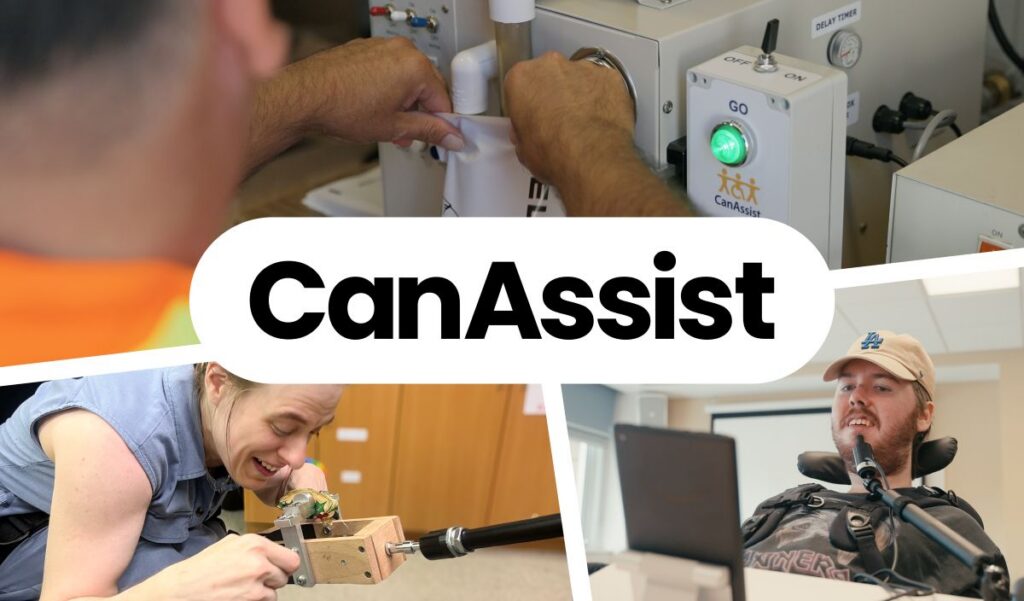
Learn how CanAssist makes customized technology to help people with disabilities overcome specific workplace barriers.
Supporting creativity and independence through customized tools
Ashley is a talented textile artist who creates detailed textile and soft sculpture pieces. Some of the hands-on tasks to prepare materials made it difficult for her to work independently.
CanAssist customized their Switch Accessible Scissors that allow Ashley to cut fabric on her own. They also developed a Stitch Pony that holds her work securely in place, making it easier to work with fabric. These customized tools allow Ashley to complete projects independently, much more quickly, and with less physical effort.
“Thank you for giving me a chance to fly!”
Ashley, CanAssist client
A collaborative process
- Deep listening to understand a person’s needs, goals, and environments.
- A collaborative, iterative process to ensure a user-centred design. (Doing it over and over again until it works.)
- Making a prototype, then testing and refining it.
- Delivery of the tech, including training and ongoing support.
To get started, visit the CanAssist website.